
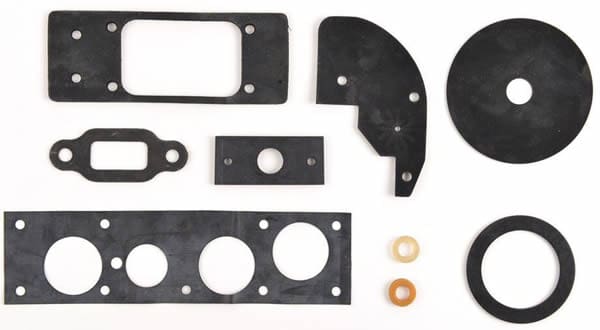
Choosing the correct rubber washer material is critical to sealing performance, durability, and long-term reliability. Nitrile and neoprene washers are two of the most commonly specified elastomer options, yet each performs very differently depending on the environment. At Stephens Gaskets, we manufacture nitrile and neoprene washers to exact specifications, helping customers select the right material for real-world operating conditions.
With over 70 years of experience supplying precision washers, gaskets, and shims, we understand that correct material choice prevents premature failure, leakage, and unnecessary maintenance.
What Are Rubber Washers Used For?
Rubber washers are used to seal, cushion, isolate, and protect components within mechanical assemblies. They help prevent fluid leakage, reduce vibration, absorb shock, and protect mating surfaces from damage.
Correctly specified rubber washers:
- Improve sealing integrity.
- Reduce vibration and noise.
- Protect fasteners and mating surfaces.
- Extend component service life.
- Reduce maintenance and downtime.
Understanding Nitrile Washers
Nitrile rubber, also known as NBR, is a synthetic elastomer developed for resistance to oils, fuels, and petroleum-based fluids. Nitrile washers are widely used in industrial environments where chemical exposure is a primary concern.
Key Properties of Nitrile Washers
- Excellent resistance to oils, fuels, and hydraulic fluids.
- Strong abrasion and wear resistance.
- Good mechanical strength.
- Reliable sealing under compression.
- Suitable for many industrial sealing applications.
Because of these properties, nitrile washers are commonly specified for applications involving frequent exposure to oils or chemicals.
Understanding Neoprene Washers
Neoprene is a synthetic rubber known for its durability and resistance to weathering. Neoprene washers are often chosen for outdoor or general-purpose applications where environmental exposure is a concern.
Key Properties of Neoprene Washers
- Excellent weather, ozone, and UV resistance.
- Good flexibility and elastic recovery.
- High impact and tear resistance.
- Stable performance in outdoor environments.
- Effective vibration damping.
Neoprene washers are valued for their long service life in exposed or variable conditions.
Nitrile vs Neoprene Washers: Key Differences
While both materials are elastic and resilient, their performance differs significantly depending on the application.
1. Nitrile washers are best suited for:
- Oil and fuel sealing.
- Chemical and solvent exposure.
- Industrial machinery and hydraulic systems.
2. Neoprene washers are best suited for:
- Outdoor installations.
- Weather-exposed environments.
- General-purpose sealing and cushioning.
Selecting the wrong material can result in swelling, degradation, or premature failure.
Choosing the Right Washer Material
To select the correct washer material, the following factors should always be considered:
- Exposure to oils, fuels, or chemicals.
- Exposure to weather, UV, or ozone.
- Operating temperature range.
- Required sealing performance.
- Mechanical stress and abrasion.
At Stephens Gaskets, material selection is always guided by application performance rather than material familiarity.
Bespoke Nitrile and Neoprene Washer Manufacturing
Many applications require washers manufactured to precise dimensions, thicknesses, and hardness levels. Stephens Gaskets specialises in bespoke rubber washer manufacturing.
We supply:
- Custom nitrile washers.
- Custom neoprene washers.
- Precision thickness control.
- Prototype quantities through to high-volume production.
Our manufacturing processes ensure consistent quality and repeatable performance across all orders.
Why Choose Stephens Gaskets as Your Washer Supplier?
Customers choose Stephens Gaskets because we combine material expertise with manufacturing precision.
Working with us gives you:
- Experienced nitrile and neoprene washer specialists.
- Bespoke manufacturing capability.
- ISO 9001-certified quality systems.
- Reliable UK-based supply.
- Technical support throughout specification and delivery.
FAQs
1. What is the difference between nitrile and neoprene washers?
Nitrile washers offer superior resistance to oils and fuels, while neoprene washers excel in weather resistance and durability for outdoor environments.
2. Which washer material is best for oil and fuel applications?
Nitrile washers are typically the best choice for oil, fuel, and petroleum-based fluid exposure.
3. Are neoprene washers suitable for outdoor use?
Yes. Neoprene washers perform exceptionally well in outdoor environments due to their resistance to UV, ozone, and weathering.
4. Can Stephens Gaskets manufacture custom rubber washers?
Yes. We manufacture bespoke nitrile and neoprene washers to custom sizes, thicknesses, and hardness levels.
5. How do I request a quote for nitrile or neoprene washers?
To request a quote, contact Stephens Gaskets with your washer dimensions, material requirements, quantities, and application details. Our team will provide a tailored quotation.
Speak to a Washer Specialist
If you are unsure whether nitrile or neoprene washers are right for your application, speak directly with Stephens Gaskets.
Our specialists will help you specify and manufacture a washer solution that delivers long-term reliability.
Contact Our Team
Phone: +44 (0)121 544 5808
Email: sales@stephensgaskets.co.uk to discuss your requirements.
Visit Our Website
Address: Stephens Gaskets Ltd, 19 Hainge Road, Tividale, Oldbury, West Midlands B69 2NR.